
Wiccan, Witch or Pagan?
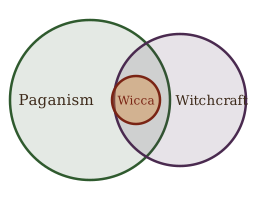
Sooner or later someone will ask you what you are. It may be a friend, a colleague, a nervous aunt, or the person beside you at a Sabbat who has noticed your pentacle. This page is about finding words you can stand behind, and about the manners that go with them.
Six sentences worth learning
The overview draws the map in prose. The Pagan Awareness Network in Australia boils it down to six sentences in one of its leaflets, and we have never seen it done better. Here they are, with our own notes.
- All Wiccans are pagan. Wicca is one religion within the pagan family, as Methodism is one church within Christianity. A few Wiccans dislike the word "pagan" and would rather be called Wiccan and nothing else, which is their right, but the family likeness is plain.
- Not all pagans are Wiccan. Most are not. A Heathen pouring mead for Thor, a Druid in an oak grove and a Hellenist leaving barley on the hearth for Hestia are all pagans, and none of them would thank you for calling them Wiccan.
- Not all pagans are witches. Plenty of pagans pray, make offerings and keep festivals and never cast a spell in their lives. Some do not believe magic works at all. Religion and spellcraft are different things, and many pagan paths have only the first.
- Not all witches are Wiccan. Witchcraft is a practice, and it is far older and wider than Wicca. Traditional witches, folk witches, hedge-riders and eclectics may never have stood in a Wiccan circle and may not want to.
- Not all witches are pagan. There are Christian witches, Jewish witches, Buddhist witches and witches who keep no gods at all. We say more in Witches of Every Faith and None.
- Nearly all Wiccans are witches. Wicca was presented from the start as a religion of witches; Gardner's first book about it was called Witchcraft Today. But a few Wiccans keep the Goddess, the God and the Sabbats and leave spellcraft alone, and some avoid the word "witch" because it could still cost them at work or at home. We would say they are witches where it counts. They are entitled to choose their own word.
Side by side
A table flattens things, and every cell below has exceptions sitting quietly in it. But newcomers ask for one, so here it is.
| At a glance | Paganism | Witchcraft | Wicca |
|---|---|---|---|
| What it is | A family of religions | A practice, an art, a craft | One religion of witchcraft |
| Gods | Many gods, one pantheon, the divine in nature, or a mixture | Whatever the witch keeps, or none | The Goddess and the God, often honoured under particular names |
| Ethic | Varies by path: honour, hospitality, frith, virtue, right order | The witch's own, or their religion's | The Rede: an it harm none, do what ye will |
| Festivals | Varies by path; many keep the solstices | None required | The eight Sabbats and the full moons |
| Magic | Central to some paths, absent from others | The whole point | Usual, and worked in a cast circle |
| How you begin | By honouring the gods or the land | By practising | By initiation into a coven, or by self-dedication |
| How old | Ancient roots; a modern revival since the nineteenth century | As old as people | Public since the 1950s |
Questions to sit with
If you are not sure which word fits, do not take a quiz. Ask yourself, slowly, over a few moons. Write the answers in your Book of Shadows and read them again in a year.
- Do you feel drawn to honour a Goddess and a God, as partners whose story is told in the turning seasons? If so, Wicca may be your home.
- Does the Rede sit well with you as a law to live by, and not merely a nice idea? Wiccans take it as binding. Better to know before you begin whether you can.
- Are you drawn to the gods of one particular people: the Norse, the Greeks, the Irish, the Egyptians? Then one of the paths in The Wider Pagan Family may fit you better than Wicca, and its people will have a great deal to teach you.
- Is it the practice you love: the herbs, the candles, the cards, the moon, the making of things, without much feeling for gods at all? Then you may be a witch who is not Wiccan, or a witch who is not pagan, and that is no lesser thing.
- Do you believe in anything you would call holy? It is perfectly possible to love the Greek myths, wear Thor's hammer and own every film with a witch in it without being a pagan. Paganism is a religion. If nothing in you wants to pour out wine for a god, thank the land, or keep a feast day as sacred, you are a person of good taste and wide reading, which is a fine thing to be. You are welcome at our fire either way.
Your answers will change. Several of our Hearthkeepers came in as one thing and are now another, and one has changed back twice. The words are tools for describing a path, not fences for keeping you on it.
Where the words came from
Pagan was a Roman word for a country person, and became a Christian word for everyone who kept the old gods; we tell that story on What is Paganism?
Witch comes from the Old English wicca, a man who worked magic, and wicce, a woman who did. For most of its life it was an accusation, not a name anyone chose. Across Europe the people who healed and charmed and found lost things called themselves wise women, cunning men, charmers and fairy doctors, and "witch" was what their enemies called them. The modern reclaiming of the word is a deliberate act, which is why some of us use it with pride and some with care.
Wicca is younger than you might think. Gerald Gardner wrote of "the witch cult" and "the Old Religion," and called its members "the Wica," with one c, which he took to mean the wise people. Only in the 1960s did "Wicca" settle down as the name of the religion itself. That is why older witches sometimes say "the Craft" where a newcomer would say "Wicca," and why the two words still get muddled in the newspapers: one was made from the other.
Manners between the paths
Most of the friction in pagan spaces is not about theology. It is about one person assuming that everyone else keeps their rules. A few courtesies go a long way.
- Ask what people call themselves, and use it. If someone tells you they are a Heathen, they are not "basically Wiccan." If they tell you they are a witch and a Catholic, believe them.
- Do not lead with the Rede. If a witch who is not Wiccan asks for advice, answering with the Threefold Law is like answering a Buddhist's question with a Bible verse. It is our law, and we hold to it gladly, but it is not theirs. Many people came to the Craft because they were tired of being told what they must believe. Do not become the thing they left.
- And the other way round. If a Wiccan asks for help with a problem, do not suggest a hex. You may think the Rede too tidy; they have promised to keep it, and you would be asking them to break a promise.
- Do not assume the calendar. Not every pagan keeps the eight Sabbats. A Heathen friend may be keeping Winter Nights while you keep Samhain, and a Hellenist may be keeping neither. See Other Wheels.
- Do not rank the paths. Initiated and self-taught, coven and solitary, old-minded and newly made: every one of them has people in it who are wiser than you and people who are sillier, and the proportions are about the same everywhere.
What the Hearth calls itself
All three, mostly, and not all of us all three. The Hearth is rooted in Wicca, so as a body we are Wiccan, pagan and witches at once. But our Druid does not answer to "Wiccan," our Heathens do not call themselves witches, and our Christian friends who honour Brigid would not call themselves pagan, and every one of them belongs at this hearth. One of our oldest friends, asked at Kitchen Table what she was, thought for a long time and said "a patchwork quilt." We have yet to hear a better answer.
Next: Beliefs and Ethics