
Brighid of the Hearth
She is the fire in the hearth, the fire in the forge, the fire in the head of the poet. She is the well that heals and the hand that delivers the child. She is the goddess who became a saint without ever stopping being a goddess, and for fifteen hundred years no one has quite managed to put her flame out.
The goddess
In the Irish sources, Brighid is the daughter of the Dagda, the great father-god of the Tuatha Dé Danann. Cormac's Glossary, written around the ninth century, describes her as a goddess of poetry worshipped by the poets, and says she had two sisters of the same name, one a goddess of healing and one of smithcraft, "from whose names all the Irish called a goddess Brigit." So she is triple, but her three faces are three crafts rather than three ages: the word, the cure and the forge. All three are fire. All three transform.
Her name is usually taken to mean "the exalted one" or "the high one." She had a sacred cow who gave endless milk, a sacred oak at Kildare, which means "church of the oak," and a reputation for protecting livestock, women in childbirth, and anyone on a threshold. She is said to have invented keening, the Irish lament for the dead, when her son Ruadán was killed; grief and poetry were hers together from the beginning.
The saint
When Christianity came to Ireland, Brighid did what strong gods do: she adapted. Saint Brigid of Kildare, who lived in the fifth and sixth centuries, founded the great monastery there and was given almost every attribute of the goddess: her feast day of 1 February, her cow, her oak, her healing wells, her generosity, and her fire. The monastery at Kildare kept a perpetual flame tended by nineteen nuns, and the twelfth-century writer Gerald of Wales records that on every twentieth night the nuns left the fire to the saint herself, saying "Brigid, guard your fire. This is your night." It burned until the Reformation put it out in the 1500s. In 1993 the Brigidine Sisters relit it in Kildare town, where it burns today.
We honour both. Many of us are not Christians and do not pray to the saint; but we are not foolish enough to think a goddess can be divided from the woman who carried her through a thousand years of winter. Among Irish Catholics, pagans, and the hundreds of thousands of women simply named for her, Brighid has never been out of work.
Her feast: Imbolc
The first of February is hers. The ewes' milk comes in, the light lengthens, the snowdrops come up through the hard ground, and in the old houses her bed was made by the fire and her cross was woven and hung above the door. We keep Imbolc as our patron festival and the night of our dedications, and we have written about it at length.
Her symbols
- The flame
- Hearth fire, forge fire, the fire of inspiration. Her perpetual flame is kept by flamekeeping cells around the world, including ours. See Flamekeeping.
- The well
- Holy wells dedicated to her are found all over Ireland and Britain, hung with rags, clooties, left by people asking for healing. Fire and water together: she is a goddess of both.
- The cross
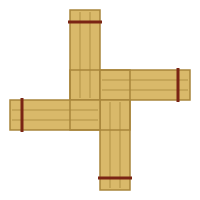
- Four arms of rushes woven around a square, hung above the door for protection against fire, lightning and ill luck. Learn to make one in Weaving Brighid's Cross.
- The mantle
- The brat Bríde, her cloak, which in the legend spread across the plain of Kildare to claim land for her monastery. A cloth left out on Imbolc Eve takes her blessing and is kept for healing.
- The white cow, the oak, the serpent, the lark
- Her animals and trees. The serpent is said to emerge from the hill on her day, a sign that the year has turned.
- The anvil
- She is the smith's goddess, the one who makes the useful and the beautiful out of raw ore by heat and hammering. We think that is a fair description of what a spiritual path does to a person.
Why we chose her
Because the hearth is the heart of the house and we wanted a place that worked like one. Because she is a goddess of thresholds and most of the people who find us are standing on one. Because she heals and we needed healing. Because she is a poet's goddess and the Craft is, in the end, a kind of poetry. Because she is Irish and several of us are. Because she does not belong to one religion, and neither do we. And because her flame, by every account, is extremely hard to put out.
Brighid, excellent woman, sudden flame, may the bright fiery sun take us to the lasting kingdom.
From an early Irish hymn to Saint Brigid, often used by both pagans and Christians