
Weaving Brighid's Cross
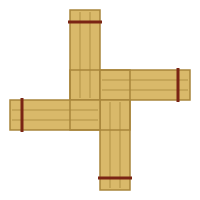
It takes about twenty minutes the first time and five the fifth. We make them every Imbolc, hang them above the doors, and burn the old ones. There is no better spell for a house than one you have made with your own hands out of grass.
What you need
- About 16 to 24 rushes, each at least 30 cm long. Soft rush (Juncus effusus) is traditional, pulled rather than cut and gathered the day before. If there are no rushes where you are, use wheat or oat straw soaked overnight, long grass, raffia, pipe cleaners for children, or strips of paper. The goddess is not fussy.
- Four pieces of thread, wool or thin ribbon for the ends. Red is traditional and protective.
- A bowl of warm water if your material is dry and brittle. Soak it for an hour and it will bend without snapping.
- Someone to talk to while you do it. This is not strictly necessary but it is how it has always been done.
The weaving
- Take one rush and hold it vertically. This is the spine of the cross.
- Fold a second rush in half and hook the fold around the middle of the first, so the two halves point to the right. You now have a T lying on its side.
- Turn the whole thing a quarter turn anticlockwise, so the arm you just added points downward and the first rush is horizontal.
- Fold a third rush in half and hook it over the arm that now points down, with its halves pointing to the right, lying over the horizontal rush. Hold the centre firmly with your thumb.
- Turn a quarter anticlockwise again, and add a fourth rush in the same way: fold, hook over the downward arm, halves pointing right.
- Keep going. Every time: turn a quarter anticlockwise, fold a new rush, hook it over the arm that points down, lay its halves to the right. The centre will start to form a woven square as the arms build up. Add rushes until the square is as big as you like, usually four to six rounds.
- Tie the ends. When you have finished, hold the centre tightly and bind each of the four arms a few centimetres from the end with your thread. Trim the ends square.
- Let it dry flat, under a book if it wants to curl. Rushes shrink as they dry; retie the ends after a day if they loosen.
If your cross turns out lopsided, it is still a Brighid's cross. Ours always are. The old crosses were made by firelight by people with cold hands, and they protected their houses perfectly well.
Hanging and blessing
The cross goes above the main door of the house, inside, on Imbolc day. Some houses hang one above every door and one in the byre; a few in the car. We say, as we hang it:
Brighid, this is your cross, made by my hands from the land's own grass. Guard this house from fire and storm, from hunger and from harm. Let all who pass beneath it come in peace and go in blessing. Stay with us until the wheel comes round.
The cross stays up until next Imbolc. It will fade from green to pale gold over the year, which is how it should look. When the new one is made, the old one is given to the Imbolc fire with thanks, or, where there is no fire, buried in the garden or placed in the rafters, where old crosses were traditionally kept, so that a house might have a hundred years of them above its head.
Other forms
The four-armed cross is the commonest but not the only one. Three-armed crosses were made in some parts of Ulster. Diamond and lozenge shapes, woven on crossed sticks, come from the midlands and west. There are wheel crosses, interlaced crosses, and crosses with a plaited border. If you learn the four-armed one, you can work out most of the others by looking at a picture and swearing a bit.